
The Knowledge Base Revolution: From Static Documents to Living Intelligence
Jun 19, 2026
By Sam Harper
A living knowledge base updates continuously instead of on a fixed review cycle, replacing static documents with a feedback loop: AI answers get flagged when wrong, corrections are batched, a reviewer approves them, and the update publishes back to the AI within minutes rather than the quarterly or annual cycle most knowledge bases follow.
Your AI support agent just told a customer the refund window is 30 days. It’s actually 60. The customer escalates. Your team wastes 20 minutes untangling the mess. Everyone loses.
This isn’t a training problem. It’s a knowledge problem.
Behind every inaccurate AI response sits a static knowledge base — a PDF uploaded six months ago, a Confluence page last edited by someone who left the company, a policy document that was “definitely updated” but never synced to the model. These documents don’t just sit there. They rot. And when they rot, your AI absorbs the decay.
Most companies still treat knowledge management like it’s 2008. They write documents, file them in shared drives, and review them quarterly — if they’re lucky. The result? AI systems trained on expired information, producing answers that sound confident and are completely wrong. This is the static knowledge trap. It’s costing you customers, burning out your team, and undermining every dollar you poured into AI automation.
The hard truth: your AI cannot outperform your knowledge infrastructure. A model with access to stale, fragmented, poorly structured documents will generate stale, fragmented, poorly structured responses. No amount of prompt engineering fixes broken source material.
This post is about a different approach. One where knowledge isn’t stored — it’s alive. Where documents don’t sit in folders — they evolve. Where the gap between a policy change and an AI response update is measured in minutes, not quarters.This is the thinking behind Chatlyst Knowledge.
Welcome to the knowledge base revolution.
Why Quarterly Updates Fail in a Real-Time World
Let’s talk about how traditional knowledge bases actually work in practice.
A support team at a mid-sized SaaS company maintains roughly 400 policy and product documents. Industry averages from APQC and ServiceNow research suggest these documents get reviewed quarterly at best. Some annual. Many are only touched when someone complains loud enough.
Between reviews, products ship. Pricing changes. Integrations break. Compliance rules shift. Refund policies get updated in legal but never reach the support wiki. A new API endpoint launches but the developer documentation lives in a Google Doc that nobody linked to the knowledge base.
The math is brutal. If you review quarterly, your knowledge base is potentially wrong for two-thirds of the year. During that window, your AI is guessing. And guessing at scale is expensive.
Here’s what that looks like in real numbers. A support team handling 10,000 tickets per month might see 15-20% of those tickets tied to policy or product information. When the AI gets it wrong, the ticket escalates to a human. Each escalation costs $8-15 in agent time. That’s $12,000-30,000 in unnecessary cost per month — just from outdated knowledge.
But the real damage isn’t financial. It’s trust. Every time your AI gives a wrong answer, the customer learns something: I can’t trust this. They stop using self-service. They demand human agents from the first message. Your AI-first strategy collapses because the foundation is cracked.
Quarterly updates made sense when knowledge lived in three-ring binders. They don’t make sense when your AI is answering questions at 2 AM to a customer in a different timezone who expects accuracy. The world moved to real-time. Knowledge management stayed in quarterly cycles. That gap is where customer experience goes to die.
The Hidden Cost of Outdated Knowledge
The symptoms are everywhere once you know what to look for.
Agent burnout from repeated corrections. Your human support team spends their first five minutes of every shift fixing AI mistakes. “Actually, we changed that policy last month.” “That pricing tier doesn’t exist anymore.” “The integration process is different now.” This isn’t augmentation — it’s babysitting. Morale drops. Turnover rises. You lose your best people to companies with better tooling.
Escalation cascades. A single wrong AI answer doesn’t just create one escalation. It creates a chain. The customer gets frustrated. The agent spends extra time apologizing and correcting. A supervisor gets pulled in. Sometimes the issue gets written up in a customer health report and passed to the account team. What could have been a 30-second AI resolution becomes a 25-minute multi-team incident.
Decision paralysis on updates. Because updating the knowledge base is slow and painful, teams avoid it. They know that changing one policy document means hunting down every related page, checking for cross-references, and hoping nothing breaks. So they delay. The knowledge debt compounds. Eventually the accumulated inaccuracy forces a massive, expensive overhaul that nobody has time for.
Brand erosion. Every wrong answer is a micro-betrayal. Customers don’t think “the knowledge base was out of date.” They think “this company doesn’t know what it’s doing.” Multiply that across thousands of interactions and you’re not just losing efficiency — you’re losing reputation.
The question isn’t whether outdated knowledge is hurting you. The question is whether you’re measuring it. Most teams aren’t. They track resolution time and CSAT without ever asking: how many of these tickets only exist because our AI was working with bad information?
The answer is usually: too many.
The Paradigm Shift: From Documents to Intelligence
We need to stop thinking about knowledge as files and start thinking about it as infrastructure.
A document is static. It has an author, a date, a version number if you’re fancy. It sits in a system and waits to be read. Documents work fine for novels. They fail at scale for operational knowledge.
Intelligence is different. Intelligence is connected. It knows when something related to it has changed. It can be questioned, corrected, and improved without a complete rewrite. It carries context — who said this, when, why it matters, and what might contradict it.
This is the shift: from document-centric knowledge management to intelligence-centric knowledge management.
In a document-centric world, the knowledge base is a library. You go there to find information. If the book is outdated, tough luck. In an intelligence-centric world, the knowledge base is a nervous system. It senses changes. It routes signals. It heals itself when damaged.
This isn’t science fiction. It’s what happens when you treat knowledge as a living system with feedback loops, governance controls, and continuous integration — the same principles that transformed software development over the past two decades.
The breakthrough insight is simple: your AI agents and your knowledge base should be in constant conversation. When an AI gives a wrong answer, that signal should flow directly back into the knowledge system. When a document gets updated, that change should propagate to every AI that depends on it. When a correction is made, it should be batched, reviewed, and published in minutes — not months.
This is what we call living knowledge. And it’s the foundation of Chatlyst’s Knowledge Consolidation infrastructure.
Inside Chatlyst’s Knowledge Consolidation: Four Layers of Living Intelligence
Chatlyst’s Knowledge Consolidation (KC) infrastructure is built on four layers, each solving a specific problem that traditional knowledge bases ignore.
Layer 1: Document Hygiene and Normalization
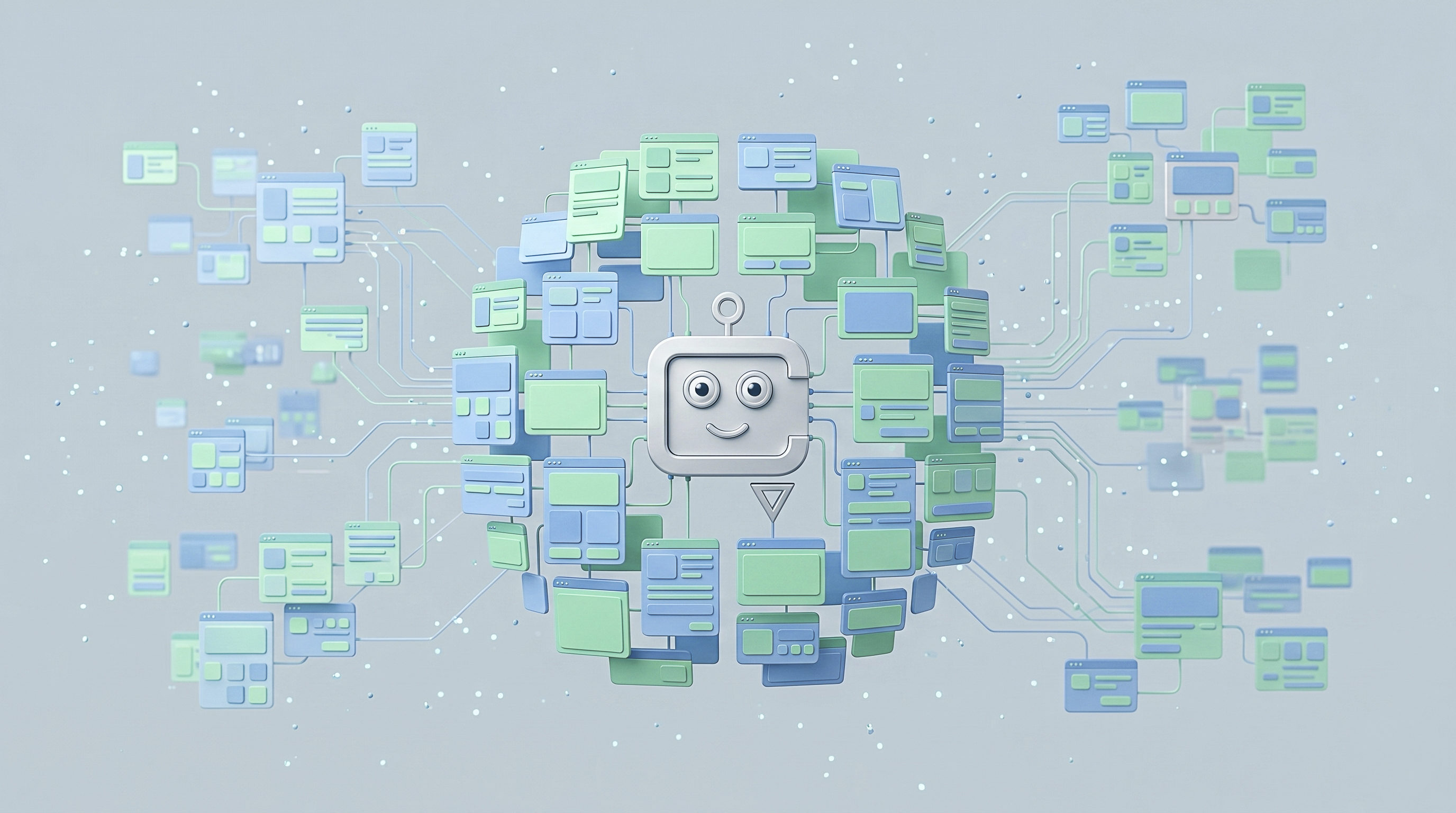
Raw documents are messy. A Confluence export contains macros, stale comments, and broken links. A PDF has formatting artifacts that confuse AI parsers. A Google Doc has track-changes comments and suggested edits that aren’t approved. Git repositories contain code snippets mixed with documentation, branch-specific files, and legacy versions that should have been archived.
The KC ingestion pipeline normalizes everything. It strips artifacts, resolves cross-references, and structures content for AI consumption. Think of it as a pre-processor that turns whatever your team produces into clean, structured intelligence. No manual formatting. No “please use the template.” The pipeline handles the mess so your team can focus on the content.
Layer 2: Continuous Feedback Collection
Every AI interaction is a potential signal. When a customer challenges an answer, when an agent provides a correction, when a response gets flagged during review — these signals are captured, deduplicated, and routed to the knowledge system.
The KC Bot monitors these signals in real-time. It identifies patterns: the same correction appearing three times in a week, a new question that no document addresses, a contradiction between two policy pages. These aren’t logged and forgotten. They’re turned into actionable knowledge tasks.
Layer 3: Batched Correction and Review
Here’s where the magic happens. The KC Bot can batch up to 50 corrections at once. Instead of your team chasing individual issues, they get a curated review queue with context, frequency data, and suggested fixes.
A knowledge manager reviews the batch, approves or modifies each correction, and publishes. The full cycle — flag → batch → review → publish — takes under five minutes. Compare that to the traditional workflow: flag → wait for quarterly review → argue about ownership → maybe update → hope the AI picks it up.
This batching system is what makes living knowledge sustainable at scale. Without it, you’d drown in micro-updates. With it, knowledge maintenance becomes a manageable, measurable workflow.
Layer 4: Version Control and Governance
Every update carries risk. Change a refund policy and you might break responses to pricing questions that reference it. Remove a deprecated feature and an old integration guide might lose context.
KC’s version control system maintains rollback safeguards for every update. Changed your mind? One click reverts. Need to see who approved what and when? The audit trail is complete. Document histories aren’t hidden in page revision tabs — they’re first-class governance features.
This is enterprise-grade control designed for teams that can’t afford to get knowledge wrong. Compliance teams love it. Legal teams love it. Support managers who’ve been burned by untracked changes love it most of all.
The Five-Minute Feedback Loop in Action
Let’s walk through what this looks like in practice.
A customer asks about API rate limits. The AI responds with the old tier structure — 1,000 requests per minute for Pro plans. But last week the engineering team bumped Pro to 5,000. The customer corrects the AI: “Actually, I was told it’s 5,000 now.”
Flag. The AI captures the correction signal. The KC Bot scores it based on confidence, source reliability, and frequency of similar signals. If this is the first time, it enters a watch list. If it’s the third time this week, it escalates to the review queue.
Batch. Within the hour, the knowledge manager sees three related signals about rate limits in their KC review queue. The bot has already identified the source document, highlighted the outdated section, and suggested the correction based on the customer feedback and a quick reference to the latest API changelog.
Review. The knowledge manager reviews the batch. Three corrections. One is a direct policy change — the rate limit increase. Two are related — the documentation page references the old limit in an example, and the FAQ table needs updating. The manager approves all three with two clicks.
Publish. The corrections push live. The AI’s knowledge base updates. The next time anyone asks about rate limits, the answer is correct. Total elapsed time: under five minutes from review start to publish.
This isn’t a demo scenario. This is how Chatlyst customers operate daily. The five-minute feedback loop replaces the quarterly review cycle. Living knowledge replaces static documents.
Version Control and Governance for Enterprise Teams
Enterprises don’t just need speed. They need safety. A fast wrong update is worse than a slow right one.
That’s why KC treats governance as a core feature, not an afterthought.
Every update creates a version snapshot. You can see exactly what changed, who approved it, and when it went live. This isn’t buried in a system log — it’s surfaced in the review interface. Knowledge managers can compare versions side by side before approving.
Rollback is one click. If a published correction causes unexpected behavior — maybe an updated policy interacts with a document that wasn’t in the review batch — you revert instantly. The old version is restored. The AI resumes using the previous knowledge. Your team investigates without customer-facing chaos.
Role-based approvals. Not everyone can publish everything. KC supports configurable approval workflows. Policy changes might need legal sign-off. Product updates might need engineering review. Pricing changes might need finance approval. The system enforces these rules automatically.
Audit trails for compliance. SOC 2 auditors ask about knowledge management controls. Regulatory frameworks like GDPR require documented accuracy of customer-facing information. KC’s version histories provide clear, exportable audit trails. You can prove not just that your AI is accurate — but that you have a controlled process for keeping it that way.
This is the governance layer that lets enterprises move fast without breaking trust. Speed and safety aren’t trade-offs. They’re built into the same system.

Integration With the Tools Your Team Already Uses
The best knowledge system in the world fails if it requires everyone to learn a new tool. Chatlyst’s KC infrastructure integrates directly with the platforms where your knowledge already lives.
Google Docs. Your policy team lives in Google Docs. KC connects directly, monitors changes, and pulls updates through the normalization pipeline. A policy manager edits a refund document in Google Docs. KC detects the change, processes it, and routes it for review. No copy-pasting. No manual syncing.
Confluence. Your engineering team documents APIs in Confluence. KC integrates with Confluence spaces, ingests pages, and maintains sync. When a page updates, KC knows. When a page gets archived, KC removes it from the AI’s knowledge set. The integration respects Confluence permissions, so sensitive internal docs don’t accidentally become AI-facing.
Git repositories. Your developer docs live alongside code. KC connects to Git repos, monitors documentation directories, and ingests changes on commit. Version-controlled docs stay version-controlled — but now they’re also AI-ready. Branch-based documentation previews let you test how knowledge changes will affect AI responses before they hit production.
These aren’t import/export features. They’re live, bidirectional integrations. Your team keeps working in the tools they know. KC handles the bridge between those tools and your AI’s brain.
The Numbers: 50% Fewer Policy Tickets, 20% Better AI Resolution
Let’s talk about results.
Chatlyst customers running KC infrastructure report consistent, measurable impact:
50% reduction in policy-related tickets. When your AI knows the current policy, customers don’t need to escalate for clarification. A customer support team at a fintech company saw policy ticket volume drop from 1,200 to 600 per month within six weeks of deploying KC. That’s 600 conversations that resolved correctly the first time.
20% improvement in AI-first resolution rates. Better knowledge means better first responses. An e-commerce company improved their AI resolution rate from 58% to 78% — not by changing their model, but by cleaning up their knowledge base and keeping it current. The model didn’t get smarter. It got better information.
10-point CSAT boost within one month. Customers notice when answers are right. A B2B SaaS company saw their support CSAT jump from 72 to 82 within 30 days of switching to living knowledge. The feedback was explicit: “The AI actually knew the answer this time.” That’s not a model improvement. That’s a knowledge improvement.
These aren’t vanity metrics. They’re operational indicators of a knowledge system working correctly. And they improve over time — the longer KC runs, the cleaner the knowledge base gets, the more feedback signals it accumulates, the sharper the AI becomes.
The Road Ahead: Self-Healing Knowledge Systems
We’re not stopping at five-minute feedback loops.
The next evolution of KC is the self-healing knowledge agent — an AI system that doesn’t just collect correction signals but acts on them autonomously. High-confidence, low-risk corrections get applied automatically. The system learns which changes are safe to publish without review and which need human oversight.
Imagine this: your engineering team ships a pricing change. The KC agent detects the update in your billing system, locates every knowledge document referencing the old pricing, generates the corrections, and applies them — all before your first customer asks about it. The knowledge base heals itself before the wound appears.
This is where we’re headed. The line between knowledge management and AI operations disappears. The knowledge system doesn’t just support your AI. It is your AI’s immune system — detecting infections, applying antibodies, and keeping the whole organism healthy.
The infrastructure we’re building today — the hygiene pipeline, the feedback loops, the version control, the governance layer — is the foundation for that future. Every correction signal we capture today trains the self-healing system of tomorrow.
Starting Your Knowledge Revolution
The transition from static documents to living intelligence doesn’t require ripping out everything you have. It starts with three steps.
Step 1: Audit your current knowledge state. How many documents does your AI rely on? When was each last verified? How many correction signals is your team ignoring because there’s no process to handle them? Most teams are shocked by what they find.
Step 2: Connect your sources. Link your Google Docs, Confluence spaces, and Git repositories to a system that can normalize, monitor, and manage them as a unified intelligence layer. Stop treating each platform as a separate silo.
Step 3: Close the feedback loop. Every time your AI gets corrected, that signal should flow somewhere actionable. Every time a document changes, your AI should know. The gap between knowing and doing is where living knowledge lives.
The teams that get this right will have an unfair advantage. Their AI will be more accurate, their support costs lower, their customers happier. The teams that don’t will keep wondering why their expensive AI investment underperforms while blaming the model.
It’s not the model. It’s the knowledge. Fix the knowledge, and everything else follows.
Your AI Is Only as Good as What It Knows
The knowledge base revolution isn’t about better documents. It’s about a fundamentally different relationship between your organization and its operational knowledge.
Static documents assume knowledge is a product — something you create, file, and occasionally dust off. Living intelligence treats knowledge as a process — something that flows, evolves, and improves through constant interaction with the people and systems that use it.
Your customers don’t care about your quarterly review cycle. They care about getting the right answer now. Your AI doesn’t care how polished your PDF looks. It cares whether the information inside is accurate, structured, and current.