
The Hidden Cost of Slow Response Times: What Every Minute Costs Your Business
Jun 8, 2026
By Sam Harper
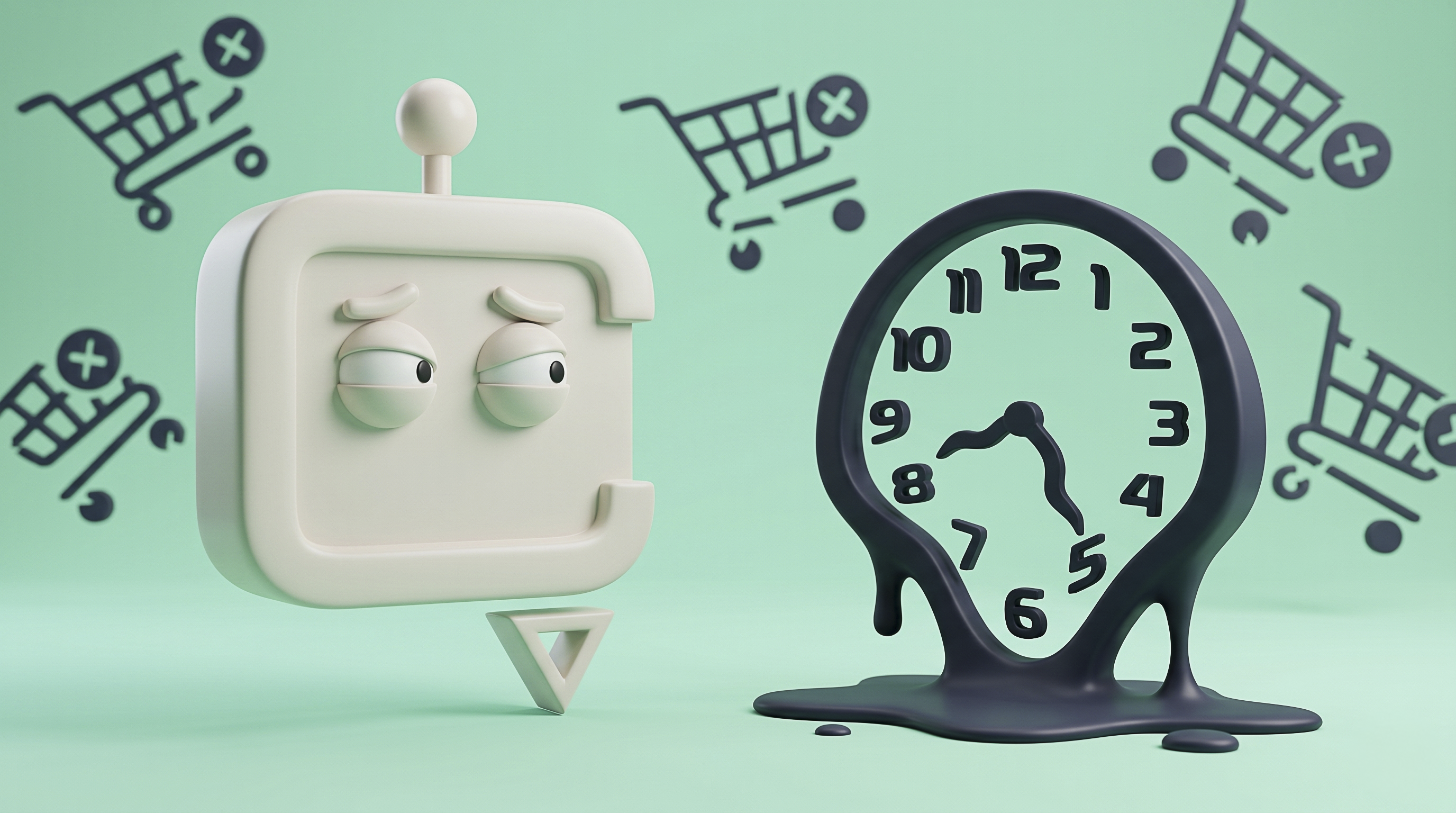
Slow response times cost sales because purchase intent fades fast: studies on lead response show contacting a customer within five minutes converts markedly better than waiting even 30, and unanswered questions are a common reason shoppers abandon a cart mid-purchase rather than complete the order.
Here’s a number that should keep every business owner up at night: 73% of customers say valuing their time is the most important thing a company can do. Not price. Not product quality. Not brand reputation. Time.
Think about that. Nearly three out of four people rank their time above everything else when deciding who gets their money. And yet the average business takes 2 to 12 minutes to respond to a customer inquiry. In some industries, it’s even longer.
Twelve minutes doesn’t sound catastrophic on paper. But translate that into what actually happens during those 720 seconds. Your customer is staring at a product page, question unanswered, credit card in hand. The doubt creeps in. They open a new tab to check a competitor. They get a notification. They remember they were supposed to send an email. And just like that — the moment of intent dissolves.
Chatlyst responds in 30 seconds on average. That’s 90% faster than the industry standard. But this isn’t a flex about speed for speed’s sake. It’s about understanding that in the modern economy, every second of delay has a price tag attached. And most businesses have no idea how much they’re actually paying.
This post breaks down the real cost of slow response times — not in abstract customer satisfaction scores, but in dollars, conversions, and lost lifetime value.
The Revenue Math Nobody Wants to Calculate
Let’s talk about the number that rarely makes it into boardroom discussions: every 1-minute delay in response time equals a 10% decrease in conversion likelihood.
Read that again. Not 1%. Not a marginal dip. A full 10% shaved off your conversion probability for every single minute your customer waits.
If your support team averages a 5-minute first response — which is actually considered decent in many industries — you’re looking at a 50% reduction in conversion probability before anyone even types a reply. Five minutes of silence, and you’ve halved your chance of closing the sale.
Here’s how this plays out with real numbers. Say you run an e-commerce store with:
- 500 support conversations per week
- An average order value of $85
- A baseline conversion rate of 12% on support-assisted purchases
At a 5-minute average response time, you’re converting roughly 6% of those conversations instead of 12%. That’s 30 lost sales per week. At $85 each, you’re bleeding $2,550 weekly — or $132,600 annually — on a single metric most businesses don’t even track.
And that’s assuming your response time is only 5 minutes. If you’re at the industry upper end of 12 minutes, the math gets brutal. Chatlyst’s 30-second response doesn’t just improve the experience — it fundamentally changes the economics of your support operation. You’re responding before the conversion window even starts to close.
The Cart Abandonment Connection
Cart abandonment is the silent killer of e-commerce revenue. The average rate hovers around 70% globally. But here’s what most retailers miss: a significant portion of that abandonment isn’t caused by shipping costs or checkout friction — it’s caused by unanswered questions at the moment of purchase.
The data is stark. After 2 minutes of waiting for a response, cart abandonment increases by 15–25%. Two minutes. That’s the threshold. Cross it, and you’re actively pushing paying customers out the door.
Even more alarming: 53% of customers abandon their purchase entirely if they don’t get an instant answer to a product question. More than half. These aren’t casual browsers — these are people who found your product, added it to their cart, and had one last question before committing. “Does this come in blue?” “Will this fit a 2019 model?” “Is this in stock for Tuesday delivery?”
Simple questions. Fast answers close sales. Slow answers — or no answers — kill them.
Chatlyst’s instant order lookup capability changes this dynamic completely. When a customer asks about their cart, stock availability, or shipping timelines, they get an accurate answer in under 30 seconds. Not an estimated response time. Not a “we’ll get back to you.” An answer. Chatlyst customers see a 32% decrease in cart abandonment specifically because questions get answered while the purchase intent is still hot.
Think about your own behavior. When was the last time you waited 10 minutes for an answer and still completed the purchase? For most people, the answer is never.
Accuracy at Velocity: Why Fast Wrong Answers Don’t Count
There’s a fair objection to the speed argument: what good is a fast response if it’s wrong?
Plenty of chatbots can fire back instant replies. The problem is those replies are often generic, irrelevant, or flat-out incorrect — and customers can smell it immediately. A wrong answer delivered in 5 seconds is still a wrong answer. It erodes trust faster than silence would.
The real competitive advantage isn’t speed alone. It’s accuracy at velocity.
Chatlyst connects directly to your product catalog, order database, inventory system, and knowledge base. When a customer asks “Is the XL in stock?” the response isn’t a templated “Please check our size guide” — it’s a real-time inventory check. When they ask “Where’s my order?” it’s an instant lookup against your fulfillment system, not a request to provide an order number and wait 24 hours.
This matters because the questions that kill conversions are almost always specific. “Will this charger work with my MacBook Pro 14-inch?” “Do you ship to Portugal?” “Is this the 2024 or 2023 version?” Generic answers don’t solve these problems. Specific, data-connected answers do.
The 30-second response time isn’t achieved by cutting corners on accuracy. It’s achieved by eliminating the human latency in the loop — the time it takes for an agent to read a ticket, look up a system, compose a response, and hit send. AI handles the lookup and response instantly. Humans stay in the loop for the complex exceptions where judgment actually adds value.
This is the model that works: AI for speed and scale, humans for nuance and escalation.

The 24/7 Revenue Protection Argument
Here’s another scenario that plays out in businesses every single night:
A customer in a different time zone — or a night owl in your own — visits your store at 11 PM. They have a question. Your support hours ended at 6 PM. Your chat widget says “We’ll be back tomorrow at 9 AM.” They leave. By morning, they’ve either bought from someone who answered their question or lost interest entirely.
This isn’t a fringe case. Over 40% of online purchases happen outside standard 9-to-5 business hours. If your support operation sleeps, your revenue leaks during those hours.
The traditional answer — hire a 24/7 team — is cost-prohibitive for all but the largest enterprises. Overnight shifts, weekend coverage, holiday schedules — the payroll math doesn’t work for most businesses.
AI support doesn’t sleep. Chatlyst operates 24/7/365 at the same 30-second response speed whether it’s 2 PM on a Tuesday or 3 AM on Christmas morning. Every inquiry gets answered. Every purchase intent gets captured. No missed opportunities.
The revenue protection angle is often overlooked when evaluating AI support tools. Companies look at the cost of the tool versus the cost of their current team. They should be looking at the revenue they’re currently losing during off-hours and comparing it against the investment in always-on coverage. For most businesses, the ROI calculation isn’t close — the revenue recovered from nights and weekends alone pays for the platform.
Industry Benchmarks vs. Chatlyst’s 30 Seconds
Let’s put the 30-second number in context.
The customer service industry has published benchmarks for years, and the picture isn’t pretty:
- Live chat: Average first response time ranges from 2 to 5 minutes depending on the sector. Retail tends toward the slower end. SaaS companies often do better but still clock in around 90 seconds at best.
- Email support: Industry average is 12–24 hours for a first response. Some sectors stretch to 48 hours or more.
- Social media: The expectation here is fastest — customers expect responses within 1 hour, though most brands don’t meet it.
- Phone: Hold times of 5–15 minutes are still common, with callback options sometimes stretching to hours.
Now stack Chatlyst’s 30 seconds against these benchmarks. It’s not a marginal improvement. It’s a different category entirely. You’re not slightly faster — you’re operating on a different time scale.
The 90% faster claim isn’t marketing language. It’s a literal comparison against the industry lower bound of 5 minutes. At 30 seconds, Chatlyst responds before most traditional support systems have even assigned the ticket to an agent.
This speed gap creates a measurable competitive advantage. When a customer is comparing your store to a competitor, and you answer their question in 30 seconds while the competitor’s chatbot says “An agent will be with you shortly” with no timeline — who gets the sale?
Real Numbers: What Speed Does to Conversion
Let’s move from benchmarks to actual business outcomes.
Chatlyst customers report an average 12% increase in support-driven revenue after implementing instant AI responses. This isn’t theoretical — it’s tracked revenue attributed to conversations that resulted in a purchase.
Here’s why this happens:
- Support conversations convert when they’re fast. A customer asking a pre-purchase question is already in buying mode. Answer fast, you close the sale. Answer slow, they cool off or buy elsewhere.
- Repeat purchases increase. When customers have a great support experience — fast, accurate, helpful — they come back. The correlation between support satisfaction and lifetime value is well-documented. Speed is the dominant factor in that satisfaction.
- Order lookup reduces refund anxiety. “Where’s my order?” is one of the most common support inquiries. When customers can get an instant, accurate answer, refund requests drop. They’re reassured, not frustrated.
- High-intent hours get captured. Late-night shoppers, weekend browsers, international customers — all segments that traditional support operations miss entirely. 24/7 instant coverage captures revenue that was previously walking out the door.
One Chatlyst merchant in the fashion accessories space saw a 32% drop in cart abandonment within the first month of implementation. Their previous setup used a hybrid of human agents (business hours only) and a basic FAQ bot that couldn’t answer specific product questions. Switching to Chatlyst meant every cart-related question got an instant, accurate answer — and the impact on their bottom line was immediate.
Speed as a Brand Differentiator
There’s a strategic layer to this conversation that goes beyond immediate conversions.
Customer service speed is becoming a brand signal. Companies known for instant support — Zappos in its heyday, Amazon with its self-service infrastructure, modern DTC brands with AI-first support — build reputation around responsiveness. It becomes part of their identity.
In a market where product differentiation is increasingly difficult — where competitors source from the same suppliers, run the same ads, offer similar pricing — the experience becomes the differentiator. And the single most impactful element of that experience is how fast you respond when a customer needs you.
Slow response times send a message, intentionally or not. They say: “Your time matters less than our convenience.” “We’ll get to you when it’s convenient for us.” “You’re a ticket in a queue, not a person ready to buy.”
Instant response sends the opposite signal. It says: “We respect your time.” “We’re here when you need us.” “Your purchase matters to us right now, not tomorrow.”
Over time, this compounds. Fast-support brands build loyalty that transcends price comparison. Customers remember who helped them in 30 seconds when they were in a rush. They don’t remember the company that got back to them the next day.
Implementation: From Zero to Live in Minutes
The most common barrier to adopting AI support isn’t skepticism about the technology — it’s the assumption that implementation is a months-long IT project requiring engineering resources and system integrations.
That assumption is outdated.
Chatlyst goes live in minutes, not months. The platform connects to your existing Shopify store, product catalog, and order management system through native integrations. No code required. No engineering tickets. No six-week project timeline.
The setup process is straightforward:
- Connect your store. One-click integration with major e-commerce platforms.
- Sync your catalog. Product data, inventory levels, pricing — all pulled in automatically.
- Configure your brand voice. Train the AI on your tone, policies, and common scenarios.
- Go live. Deploy on your site and start answering customer questions in under 30 seconds.
The entire process takes less time than most teams spend in a single weekly standup. And unlike traditional support automation projects that require ongoing maintenance and rule updates, Chatlyst’s AI improves continuously as it handles more conversations.
This matters because speed of implementation determines speed of ROI. A tool that takes 3 months to deploy pushes your payback period into the next quarter. A tool that’s live today means you’re stopping revenue leakage tonight.
The Bottom Line
Slow response times aren’t a minor operational inefficiency. They’re a direct, measurable drain on revenue that most businesses have accepted as normal.
The math is unforgiving. A 10% conversion drop per minute of delay. A 15–25% cart abandonment spike after 2 minutes. 53% of customers leaving if they don’t get instant answers. These aren’t soft metrics — they’re hard financial losses that compound daily.
Chatlyst’s 30-second average response time isn’t a feature. It’s a financial instrument. It protects revenue that would otherwise leak during delays, off-hours, and queue backlogs. It converts support from a cost center into a revenue driver. The 12% support-driven revenue growth and 32% cart abandonment reduction that Chatlyst customers experience aren’t side effects — they’re the direct result of respecting the customer’s time.
In a 73%-of-customers-want-speed world, the businesses that win will be the ones that treat response time as a strategic priority, not an operational afterthought.
The question isn’t whether you can afford to invest in instant AI support. It’s whether you can afford not to.