
Freshdesk’s Freddy AI: When “Up to 80%” Really Means 23%
Aug 3, 2026
By Hunter Stone
“Up to 80% auto-resolution.” That’s the headline Freshdesk puts front and center when selling Freddy AI, their virtual agent built into the Freshdesk helpdesk platform. It’s a compelling number. For any support manager staring down a backlog of hundreds — maybe thousands — of tickets, 80% resolution without human intervention sounds like the answer to every late-night staffing panic.
The problem? That 80% figure is aspirational at best. And in many real-world deployments, it’s nowhere close.
Here’s what actually happens when companies turn Freddy AI loose on their support queues. Total Expert, a fintech company using Freshdesk, reported a 23% resolution rate with Freddy AI — a staggering 57 percentage points below the marketed ceiling. On the other end of the spectrum, UPayments achieved 75% resolution, which sounds impressive until you realize it’s still 5 points short of the promise, and that result came from a relatively narrow use case with heavily scripted interactions.
Most Freshdesk customers land somewhere in the middle. Industry conversations with support leaders running Freddy AI in production reveal a consistent pattern: 40% to 60% auto-resolution for simple, well-structured queries. Anything complex — billing disputes, technical troubleshooting, multi-step account changes — gets routed to a human agent almost immediately.
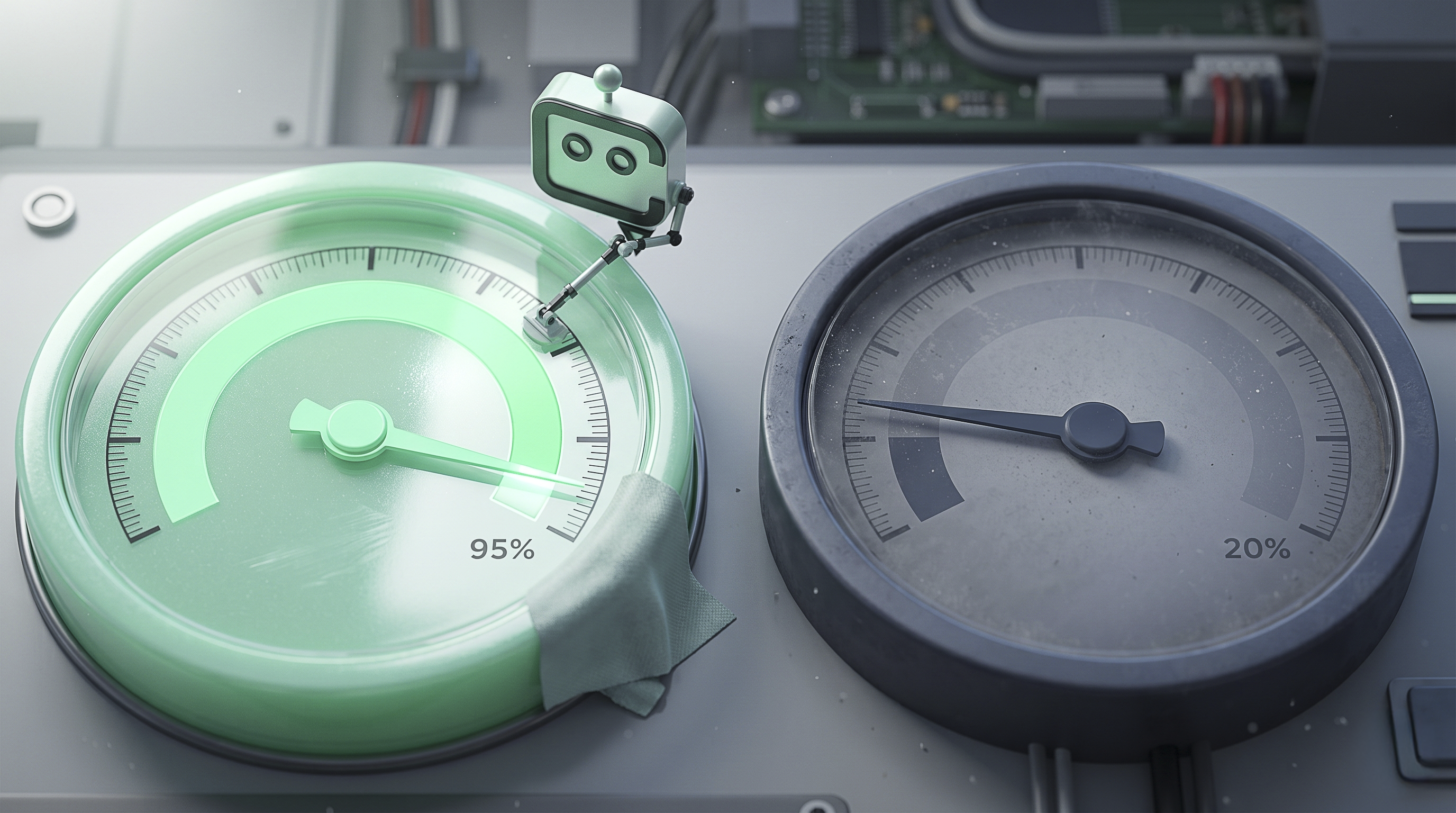
Meanwhile, Chatlyst delivers a consistent 95% auto-resolution rate across industries. That isn’t a ceiling. That’s the floor. And that 95% covers complex conversations, multi-turn interactions, and nuanced customer issues that Freshdesk’s Freddy AI routinely hands off.
The gap between 23% and 95% isn’t a rounding error. It’s the difference between AI that genuinely reduces your support workload and AI that creates more work through constant escalation.
Resolution Rates: The Numbers Don’t Lie
What “Up to 80%” Actually Means
Freshdesk’s marketing language is carefully constructed. “Up to 80%” gives them legal cover while painting a picture most buyers will interpret as “we’ll get close to 80%.” The reality, as documented across multiple case studies and user reports, is far more modest.
Total Expert’s 23% resolution rate with Freddy AI represents one of the more transparent disclosures in the industry. Their support environment involved complex financial product questions, regulatory constraints, and customers who needed personalized answers. Freddy AI handled the most basic FAQ-style queries but faltered on anything requiring context from previous interactions or nuanced understanding of product features.
UPayments’ 75% rate is often cited by Freshdesk as proof the system works. But context matters. UPayments operates in the payments processing space where a large percentage of inquiries fall into predictable categories: “Where’s my payout?”, “How do I integrate?”, “What are the fees?” These are ideal conditions for any AI agent. When your customer questions map neatly to a decision tree, resolution rates climb. That’s not intelligence — it’s scripting.
The more typical experience falls in the 40-60% range. Support leaders on G2, Reddit, and industry Slack communities consistently report that Freddy AI handles password resets, refund status checks, and basic “how do I” questions well. But when conversations deviate from expected patterns — when customers describe problems in their own words, ask follow-up questions, or bring up issues the AI hasn’t been explicitly trained on — the system defaults to human handoff.
Chatlyst at 95%: Built Different
Chatlyst’s 95% auto-resolution rate isn’t achieved by narrowing the scope to easy questions. It’s achieved through a fundamentally different approach to conversational AI.
Where Freshdesk relies on keyword matching, intent classification, and rigid decision trees, Chatlyst uses advanced natural language understanding that maintains context across entire conversations. A customer can describe a billing issue in vague terms, answer clarifying questions, provide additional details mid-conversation, and Chatlyst tracks the full thread without losing its place.
The 95% figure holds across retail, SaaS, financial services, logistics, and hospitality. That’s because the underlying architecture isn’t a bolt-on feature to a legacy helpdesk — it’s a purpose-built AI engine designed for resolution, not deflection.
Here’s the key distinction: Freddy AI was built to reduce ticket volume. Chatlyst was built to resolve customer problems. Those sound similar, but the outcomes diverge dramatically. A system that deflects 50% of tickets while resolving only 23% of them is creating invisible work — frustrated customers re-opening cases, agents picking up interrupted conversations mid-stream, support managers spending hours training the AI on edge cases it may never handle.
AI Locked Behind the Paywall
The Freshdesk Pricing Maze
Freddy AI isn’t available on Freshdesk’s entry-level plans. To access any AI capabilities, you need Freshdesk Pro at $49 per agent per month or Freshdesk Enterprise at $79 per agent per month. This isn’t a small upcharge — it’s a fundamental gatekeeping mechanism that forces mid-sized teams into expensive tiers before they can even evaluate whether the AI works for their use case.
Let’s be clear about what this means in practice. A 10-agent support team looking to add AI must commit to Freshdesk Pro at minimum. That’s $490 per month just for the base plan. But Freddy AI features within Pro are limited — for full AI capabilities including advanced automation, custom workflows, and deeper integrations, you’re pushed toward Enterprise at $790 per month.
Over a year, that 10-agent team on Pro with AI add-ons is looking at approximately $15,240. And that number doesn’t include implementation costs, training time, or the ongoing manual tuning that G2 reviewers consistently mention as a requirement.
The Reviewers Say It Plainly
G2 reviewers — verified users who’ve deployed Freddy AI in production — describe the system as “lighter in depth” compared to expectations. Multiple reviewers note that getting meaningful automation requires significant manual setup, including extensive intent mapping, response templating, and ongoing maintenance as products and policies change.
One verified G2 user running a mid-market SaaS support operation put it directly: “Freddy AI handles the easy stuff, but we spent more time configuring it than we saved on simple tickets. Anything beyond password resets and order lookups still comes to the team.”
Another reviewer noted that the AI’s understanding of context is limited: “If a customer asks three questions in one message, Freddy often only catches the first one and ignores the rest.” This context limitation isn’t a minor inconvenience — it’s a fundamental architectural constraint that forces human intervention on a significant portion of conversations.
Chatlyst: No Seat Fees, No Tier Games
Chatlyst takes a different approach to pricing entirely. There are no per-agent fees. No feature tiers that lock AI capabilities behind premium plans. You get the full AI resolution engine from day one, regardless of team size.
This pricing model reflects a different philosophy. Freshdesk’s structure incentivizes selling more seats at higher tiers. Chatlyst’s structure incentivizes actual resolution — the more effectively the AI handles your support, the more valuable the partnership becomes.
For that same 10-agent team spending $15,240 per year on Freshdesk Pro with AI, Chatlyst represents a dramatically lower investment with dramatically higher resolution rates. The math isn’t complicated. But the implications are significant — that cost difference could fund an additional support hire, a product improvement initiative, or simply drop to the bottom line.
The Session Pricing Trap: From $0.10 to $0.50
The 5x Price Hike Nobody Talks About
Freshdesk’s session-based AI pricing deserves special attention because it represents one of the most aggressive cost increases in the customer support software industry.
Freshdesk charges $0.50 per AI session — and that rate represents a 5x increase from the previous $0.10 per session. If you’re running a support operation with any volume, this isn’t a line item. It’s a budget shock.
Let’s run the numbers. A mid-sized company handling 5,000 customer conversations per month, with AI engaged for most of them, is looking at 5,000 sessions × $0.50 = $2,500 per month in session fees alone. That’s $30,000 per year on top of the base plan costs, on top of per-agent pricing, on top of any integrations or add-ons.
And here’s the critical question: what are you getting for that $0.50 per session? If the resolution rate is 23% — as Total Expert experienced — you’re paying $0.50 per session for an AI that fails to resolve the customer’s issue 77% of the time. Those sessions aren’t creating value. They’re creating friction, followed by human handoff, followed by a second interaction that costs you even more.
The Chatlyst Alternative
Chatlyst doesn’t use session-based pricing. The pricing model is straightforward and predictable, built around actual value delivered rather than per-interaction fees. For high-volume support operations, this predictability is essential — you can’t budget effectively when your AI costs scale unpredictably based on conversation volume.
The difference between $0.50 per session and a flat, predictable fee becomes stark at scale. A company handling 10,000 monthly conversations pays $5,000 per month in Freshdesk session fees alone. That’s $60,000 annually — just for the privilege of accessing an AI that resolves less than half of those conversations effectively.
Omnichannel: Truly Unified vs. Disjointed Fragments
Freshdesk’s “Omnichannel” Reality
Freshdesk markets itself as an omnichannel support platform. And technically, it handles multiple channels — email, chat, phone, social media, and messaging apps all route into the Freshdesk interface. But “handling” multiple channels and “unifying” them are very different things.
Support leaders who’ve implemented Freshdesk’s omnichannel capabilities consistently describe the experience as “disjointed” with “inconsistent interfaces.” What this means in practice is that an agent switching between a live chat conversation and an email ticket encounters different layouts, different information architectures, and different workflow patterns. Context doesn’t transfer smoothly. Customer history gets fragmented by channel.
For AI specifically, this fragmentation is a critical weakness. Freddy AI’s context window is already limited — now imagine that limited context trying to track a customer who started in chat, followed up via email, and then sent a WhatsApp message. The AI treats these as separate conversations rather than a single customer journey. Each channel restart resets the context, forcing the customer to repeat information and the AI to relearn what it should already know.
G2 reviews specifically call out this issue: “The omnichannel experience feels like separate products glued together rather than a unified platform. Our agents need to check three different screens to get full customer context.”
Chatlyst’s Unified Conversation Memory
Chatlyst was built around the concept of persistent conversation memory. When a customer interacts across multiple channels, Chatlyst maintains a unified thread of the entire interaction history. The AI doesn’t just see the current message — it sees the full context of the relationship, regardless of which channel the customer used.
This matters because real customers don’t think in channels. They think in problems. A customer with a shipping issue might start with a chat inquiry, send a follow-up email with their order number, and later DM on social media asking for an update. Chatlyst tracks this as one continuous conversation. Freshdesk tracks it as three separate tickets.
The operational impact is substantial. Chatlyst’s unified approach eliminates the repetitive “Can you confirm your order number again?” exchanges that frustrate customers and waste agent time. It means the AI can reference earlier parts of the conversation even when the channel changes. And it means that when a conversation does escalate to a human agent, that agent has complete context from every touchpoint — not just the current channel.
The Email AI Limitation That Breaks the Promise
First Message Only
Here’s a limitation that doesn’t get enough attention: Freshdesk’s AI email assistant only responds to the first message in a thread. If a customer sends a follow-up email, replies to an existing conversation, or adds new information to an ongoing thread, Freddy AI doesn’t engage. The system is architecturally incapable of processing multi-turn email conversations.
This is a fundamental design choice with massive practical implications. Email isn’t live chat — customers expect to reply, add details, ask follow-up questions. In a typical email support thread, the first message is often the least informative. It’s the follow-ups that contain order numbers, screenshots, error messages, and clarifying details.
By only processing the first message, Freddy AI is essentially optimized for the simplest possible email inquiries. Anything that requires a back-and-forth — which is the majority of substantive support interactions — gets handed to a human agent from the second message onward.
For support teams, this creates a bizarre workflow where the AI might draft an initial response to a new ticket, but every subsequent interaction in that same thread is entirely manual. The “automation” becomes a one-shot tool rather than a genuine conversational partner.
Chatlyst’s Full-Thread Email Intelligence
Chatlyst processes entire email threads, not just opening messages. When a customer replies to an existing conversation, Chatlyst reads the full context — every previous message, every attachment, every piece of information shared across the thread — and generates responses based on the complete picture.
This enables genuine multi-turn email automation. A customer can send an initial inquiry, receive a clarifying question from Chatlyst, reply with additional details, and continue the conversation through multiple exchanges — all without human intervention, provided the AI has sufficient information to resolve the issue.
For complex inquiries that span 4-6 email exchanges, this capability is transformative. Rather than a human agent managing the entire back-and-forth, Chatlyst handles the information-gathering phase, surfaces the resolution when possible, and only escalates when genuinely necessary. The time savings compound with every exchange.
The True Cost Comparison
Freshdesk: Death by a Thousand Line Items
Let’s assemble the full cost picture for a realistic 10-agent support team using Freshdesk with AI:
Freshdesk Pro plan: $49 per agent per month × 10 agents = $490 per month = $5,880 per year. But wait — for full AI capabilities, you’re likely pushed to Enterprise at $79 per agent per month, which brings the base to $790 per month = $9,480 per year.
AI session fees at $0.50 per session: For a team handling 5,000 monthly conversations, that’s $2,500 per month = $30,000 per year. If your volume is higher, this number scales linearly.
Implementation and configuration: Freshdesk reviews consistently mention significant setup time for Freddy AI. For a 10-agent team, estimate 40-60 hours of admin time to configure intents, map responses, and tune the system. At an internal loaded cost of $50/hour, that’s $2,000-$3,000 in hidden implementation costs.
Ongoing maintenance: Intent models need regular updating as products change, policies evolve, and new issue types emerge. Budget 10-15 hours per month for maintenance = $6,000-$9,000 annually in ongoing tuning costs.
Total first-year cost for Freshdesk with AI: approximately $47,480 to $51,480 for a 10-agent team handling moderate volume.
And remember — for that investment, you’re getting 23% to 75% resolution rates, AI that only reads the first email in a thread, disjointed omnichannel experiences, and ongoing manual maintenance requirements.
Chatlyst: Predictable Pricing, Superior Results
Chatlyst’s pricing doesn’t involve per-agent fees, session charges, or tiered feature access. The platform operates on a straightforward model that scales with your needs without the death-by-a-thousand-line-items approach.
For that same 10-agent team, the total annual cost is a fraction of Freshdesk’s price — while delivering 95% auto-resolution, full-thread email processing, genuinely unified omnichannel memory, and AI that doesn’t require constant manual tuning.
The cost-per-resolved-conversation math is stark. With Freshdesk at the low end of resolution (23%), each AI-resolved conversation costs you approximately $4.13 in session and platform fees alone. With Chatlyst at 95% resolution, the cost per resolved conversation is a fraction of that — and the 95% figure means the vast majority of your conversations require zero human intervention.
The Verdict: Two Different Philosophies
Freshdesk and Chatlyst represent fundamentally different approaches to AI-powered customer support.
Freshdesk built a helpdesk platform, then bolted AI onto it. Freddy AI is a feature within a larger product ecosystem, constrained by the architecture of a system designed in the pre-AI era. The “up to 80%” claim reflects marketing ambition more than engineering reality. The pricing structure — per-agent fees, session charges, tiered feature access — reflects a business model optimized for seat expansion rather than resolution quality.
The evidence from real deployments is clear: Total Expert at 23%, typical users at 40-60%, and even the best-case UPayments scenario at 75% — still 5 points short of the marketed ceiling. Combined with the first-message-only email limitation, the disjointed omnichannel experience, and the $0.50 session fee representing a 5x price increase, Freshdesk’s AI offering looks less like a genuine automation solution and more like an expensive experiment that pushes costs to customers.
Chatlyst was built as an AI resolution engine from the ground up. The 95% auto-resolution rate isn’t a marketing claim — it’s a consistent performance metric across industries, conversation types, and complexity levels. The pricing model aligns incentives: Chatlyst wins when your customers get answers, not when you buy more seats or rack up session fees.
Who Should Choose What
Freshdesk makes sense if you’re already deeply embedded in the Freshworks ecosystem, if your support volume is very low, or if your primary need is a traditional helpdesk with basic ticketing rather than genuine AI automation. If 23-50% resolution rates meet your needs and you have the budget and staff to handle the manual tuning, Freshdesk delivers a familiar product.
Chatlyst is the better choice if you need AI that actually resolves customer issues without constant human oversight, if you want predictable pricing without session fees or per-agent charges, if your customers interact across multiple channels and you need unified context, and if the idea of paying $0.50 per session for a 23% success rate sounds as absurd to you as it does on paper.
The support software market is full of “AI-powered” features that are really just rule-based automation with a new label. The gap between Freshdesk’s “up to 80%” promise and the 23% reality is one of the widest in the industry. Before committing to a platform, ask for specific resolution data from reference customers running similar use cases. The answers will tell you everything you need to know.
Ready to See What 95% Resolution Actually Looks Like?
Stop paying $0.50 per session for AI that resolves less than half your conversations. Chatlyst delivers 95% auto-resolution with no seat fees, no session charges, and no feature tiers locking capabilities behind paywalls.
Book a 15-minute demo and we’ll show you the platform running on real conversation data. No scripted demos, no aspirational metrics — just the actual resolution performance your support operation can expect from day one.